Storage tanks are critical assets in industries such as oil & gas, petrochemicals, food processing, water utilities, and manufacturing. Accurate calibration of these tanks is essential because even small dimensional errors can lead to significant discrepancies in stored volume calculations, inventory reporting, custody transfer, and revenue accounting. Traditional tank calibration methods often rely on manual strapping, tape measurements, or limited point observations, which can be time-consuming, risky, and less precise. Today, 3D laser scanning has transformed storage tank calibration by delivering faster, safer, and highly accurate results.
What is 3D Laser Scanning?
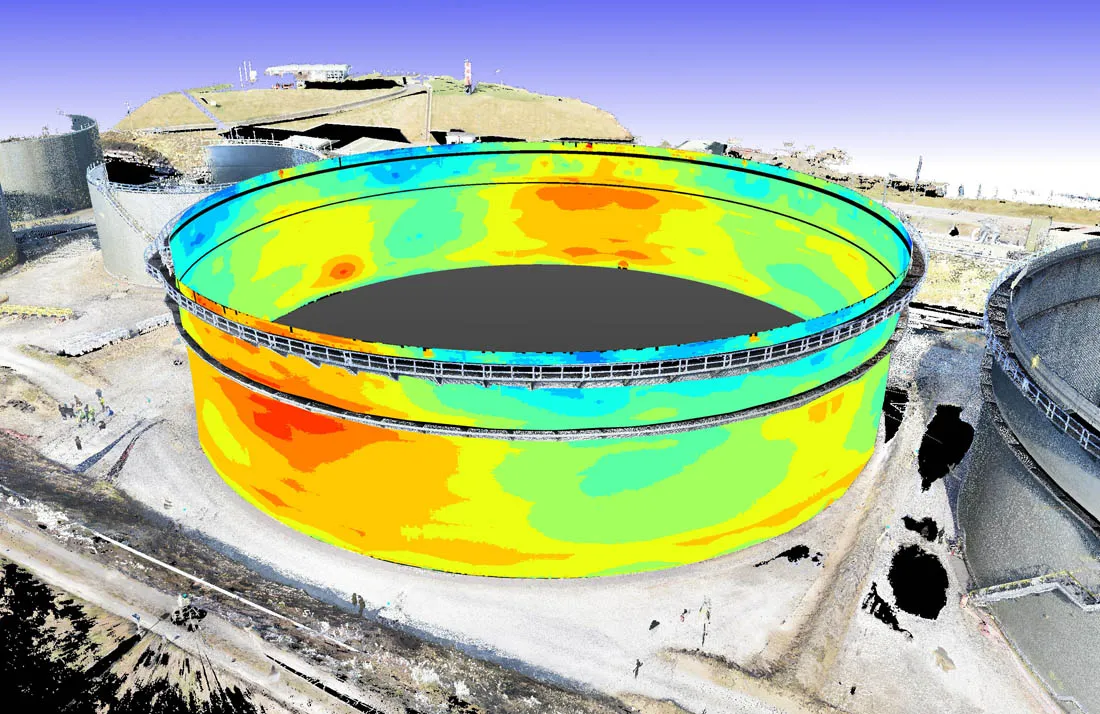
3D laser scanning is a modern surveying technology that captures millions of precise measurement points from surfaces and structures. The scanner emits laser pulses that reflect off the tank surfaces and return to the instrument, producing a dense point cloud that accurately represents the tank’s real geometry. This digital dataset can then be processed into 3D models, cross-sections, deformation maps, and calibration tables.
Why Storage Tank Calibration Matters
Tank calibration determines the relationship between liquid level and stored volume. Over time, tanks may deform due to settlement, corrosion, temperature changes, repairs, or operational stresses. If these changes are not reflected in calibration charts, inventory records may become inaccurate. This can result in product losses, billing disputes, or regulatory non-compliance.
3D laser scanning captures the true current condition of the tank, rather than assuming ideal circular or cylindrical geometry.
Key Benefits of 3D Laser Scanning for Tank Calibration
1. High Accuracy
Laser scanning measures the actual shell roundness, verticality, floor settlement, roof shape, and internal geometry with exceptional precision. This improves the reliability of calibration tables.
2. Faster Fieldwork
Traditional manual measurements can take days. Laser scanning can often capture a full tank in a matter of hours, minimizing downtime and operational disruption.
3. Improved Safety
Scanning reduces the need for personnel to climb tanks, work at heights, or enter confined spaces unnecessarily.
4. Complete Coverage
Unlike sample-based methods, laser scanning captures the entire tank surface, helping identify dents, bulges, tilt, or deformation that may otherwise be missed.
5. Digital Twin Creation
The collected data can be used to build a digital twin of the tank for future inspections, engineering modifications, and asset management.
Typical Deliverables
A professional tank calibration project using 3D laser scanning may include:
- Tank capacity / strapping tables
- 3D point cloud data
- Deformation and settlement analysis
- Verticality and roundness reports
- CAD drawings and 3D models
- Calibration certificates compliant with standards such as ISO 7507 or API guidelines
Industries That Benefit
- Petroleum terminals
- Chemical plants
- Breweries and food processing plants
- Water reservoirs
- Mining and bulk liquid storage facilities
Why Choose Optimum Geospatial Ltd
At Optimum Geospatial Ltd, we provide professional 3D laser scanning and storage tank calibration services across Kenya and Africa using advanced survey-grade equipment and expert processing workflows. Our team delivers accurate, standards-compliant results that improve operational confidence, reduce losses, and support smarter asset management.